
Packaging Machinery Blog & Insights
Discover expert articles, technical guides, maintenance tips, and latest filling automation trends from EAC Machinery Co., Ltd.
Why Choose a Powder Filling Machine for Your Business?
Powder handling looks simple until dust coats the hopper, seals, and operator gloves. A Powder Filling Machine can bring measured dosing, cleaner production, and repeatable pack weights to this difficult process. These benefits matter for flour, protein blends, spices, powdered beverages, and other compliant products. Accuracy is not merely a technical feature. It affects material waste, customer trust, and production costs.
Industry evidence supports this shift toward automation. PMMI’s 2024 State of the Industry report identifies labor availability, productivity, and operational efficiency as major packaging concerns. The International Federation of Robotics reported 541,302 industrial robots installed worldwide in 2023, showing continued investment in automated manufacturing. Grand View Research also describes packaging machinery as a growing market, driven by food safety, productivity, and flexible packaging requirements. These reports do not prove that every company needs automation. They show why the discussion deserves careful attention.
The right machine can reduce manual scooping, stabilize filling speeds, and record useful production data. For example, a ten-gram sachet line must control powder flow while limiting airborne dust. Auger fillers often handle this challenge better than simple gravity systems. Still, equipment selection is not effortless. Powder density changes. Humidity interferes. Operators need training, cleaning access, and reliable calibration procedures. A fast machine can still create expensive errors. Businesses should compare accuracy tests, changeover time, sanitation design, service support, and total ownership cost before purchasing. The best choice is not always the most automated one. It is the machine that fits the product, workforce, and long-term production reality.
What Is a Powder Filling Machine?
Why Choose a Powder Filling Machine for Your Business?
What Is a Powder Filling Machine?
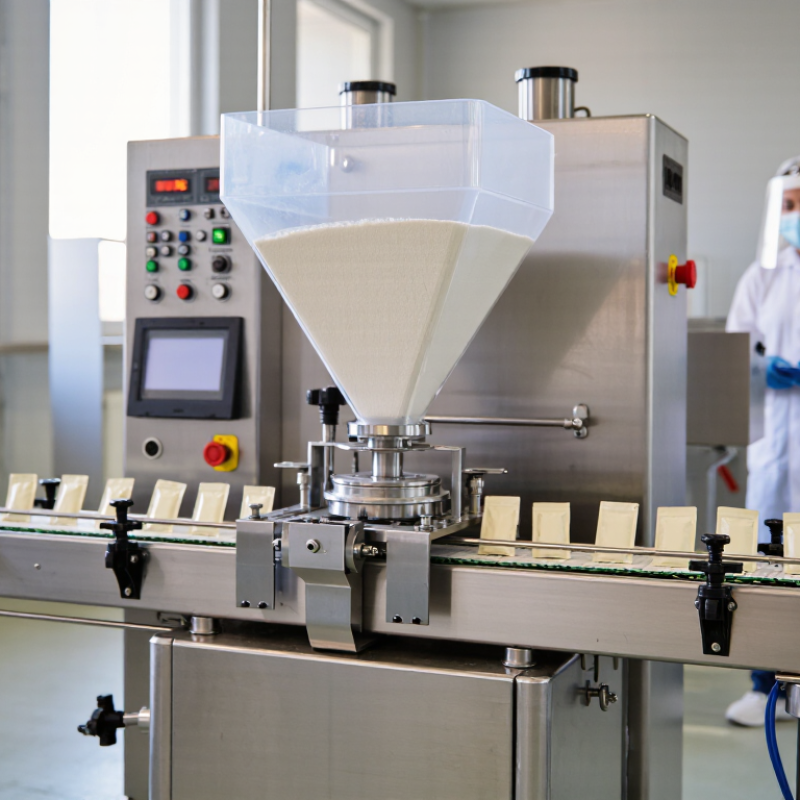
A powder filling machine measures and dispenses dry products into containers. It commonly handles flour, protein powder, spices, minerals, and pharmaceutical-grade ingredients. Its main parts include a hopper, dosing screw, motor, sensor, and control panel.
The machine may use auger dosing, volumetric filling, or gravimetric weighing. Auger systems suit many powders with consistent density. Gravimetric systems check actual weight during filling. This matters when fine powder settles differently after transport. Some models also include dust extraction and sealed contact parts. The work area stays cleaner.
The first setup is rarely final. Powder flow changes with humidity, particle size, and storage time. Operators must test speed, screw shape, and vibration. A clean trial can still mislead. Real production conditions matter more.
PMMI’s 2023 Packaging Machinery Shipments Study reported U.S. packaging machinery shipments of about 10.2 billion dollars in 2022, an 11.1% increase from the previous year. This growth reflects continued investment in automated packaging and labor efficiency. However, automation does not remove quality responsibility. Staff still need to verify fill weights, inspect seals, and record adjustments. A reliable filling process combines machine capability with disciplined operating habits.
How Does a Powder Filling Machine Work?
Why Choose a Powder Filling Machine for Your Business?
A powder filling machine measures and dispenses dry materials with controlled accuracy. The process begins when powder enters a stainless-steel hopper. An agitator keeps the material moving and reduces bridging. A screw auger then rotates beneath the hopper. Its speed and rotation time determine the delivered quantity. For higher accuracy, load cells can check each container’s weight. A control system adjusts filling parameters during production. Some machines also use dust extraction around the filling nozzle. This helps keep the workspace cleaner and protects measurement consistency. No machine is perfectly accurate, though. Powder density, moisture, and particle size can change from batch to batch.
Tips: Test the actual powder before choosing equipment. Record fill weights from several containers, not only one. Check whether the powder flows smoothly or forms compacted pockets. Clean contact surfaces between product changes. A small calibration mistake can affect hundreds of packages.
Operators should inspect the auger, hopper, seals, and sensors regularly. They should also verify the target weight with a calibrated scale. In practice, a setting that works on Monday may need adjustment later. This is not always a machine fault. Environmental humidity and material handling often influence performance. Clear operating records make these changes easier to understand. When the equipment matches the powder’s behavior, filling becomes faster, more repeatable, and easier to monitor.
Why Choose a Powder Filling Machine for Your Business?
Powder filling machines use an auger or dosing screw to measure a controlled volume of powder before transferring it into a container. The correct fill setting depends on the product’s bulk density, target weight, and package format.
These representative package sizes reflect common retail formats for powdered products. A suitable filling machine can improve dosing consistency, reduce manual handling, and support repeatable production across different fill weights.
What Benefits Does Powder Filling Equipment Offer?
Powder filling equipment offers tighter control where manual scoops create dust, inconsistent weights, and slow production. An auger filler can measure powder by volume, then adjust settings after routine weight checks. This suits flour, protein blends, spices, and other permitted dry products. Operators also gain cleaner work areas when enclosed hoppers and dust-control connections are correctly installed. Small details matter.
The financial case is broader than speed. Grand View Research valued the global packaging machinery market at USD 52.83 billion in 2023 and forecasts a 4.8% CAGR from 2024 to 2030. This growth reflects continuing investment in automated, flexible packaging lines. A powder filler can reduce product giveaway, especially when each container holds only a few grams. That saving becomes visible across thousands of units. Still, automation is not magic. Poor powder flow can cause bridging, clumping, or uneven dosing.
Equipment selection should follow actual production tests, not a brochure specification. Check bulk density, particle size, moisture, target weight, and cleaning time. The International Federation of Robotics reported 541,302 industrial robots were installed worldwide in 2023, showing strong automation momentum across manufacturing. Yet a sophisticated filler still needs trained operators and documented calibration. In real facilities, the most useful machine is often the one staff can clean, inspect, and adjust without hesitation. Mistakes here can be expensive.
Why Choose a Powder Filling Machine for Your Business? - What Benefits Does Powder Filling Equipment Offer?
| Performance Dimension | Manual Filling | Semi-Automatic Equipment | Automatic Powder Filling Machine | Business Benefit |
|---|---|---|---|---|
| Typical output | Approximately 5–20 containers per minute | Approximately 10–40 containers per minute | Approximately 30–120 containers per minute | Higher production capacity and easier order scaling |
| Filling accuracy | Typically ±2% to ±5% | Typically ±1% to ±2% | Typically ±0.5% to ±1% | Less product giveaway and more consistent package weights |
| Labor requirement | Usually 2–4 operators, depending on packaging format | Usually 1–2 operators | Often 1 operator for monitoring and material replenishment | Lower repetitive labor requirements and improved workforce efficiency |
| Dose consistency | Highly dependent on operator technique | Improved consistency through controlled dosing | Programmable dosing with repeatable settings | More uniform products and fewer customer complaints |
| Changeover time | Approximately 5–15 minutes for simple product changes | Approximately 15–45 minutes | Approximately 20–60 minutes, depending on product and tooling | Faster transitions between products when recipes and parts are standardized |
| Material waste | Higher risk of spills, overfilling, and residue | Moderate waste with improved dosing control | Lower waste when the auger, filler, and product settings are correctly matched | Better raw-material utilization and improved production economics |
| Dust management | Limited control during scooping and transfer | Can support local extraction or enclosed filling points | Often compatible with enclosed hoppers and dust-extraction systems | Cleaner work areas and reduced airborne powder exposure when properly configured |
| Data and traceability | Mostly manual records | Basic counters and operator records may be available | Digital counters, recipe storage, and batch monitoring may be available | Improved production tracking and easier quality-control documentation |
| Best suited for | Small batches, testing, and low-volume production | Growing businesses and moderate production volumes | High-volume, repeatable, and continuous production | A scalable solution for businesses seeking reliable output and lower unit costs |
Note: The figures shown are typical industry ranges for powder-filling applications. Actual speed, accuracy, changeover time, labor requirements, and dust-control performance depend on powder characteristics, container size, dosing method, machine configuration, and operating conditions.
Which Industries Use Powder Filling Machines?
Powder filling machines serve many industries because they handle dry, measured materials with speed and consistency. In food production, they fill flour, spices, coffee, protein powder, and baking mixes into pouches, jars, or sachets. A stable filling system can reduce spills around the conveyor and keep each package closer to its target weight.
Pharmaceutical and nutraceutical facilities use powder fillers for carefully controlled ingredients, including supplements and approved medicines. These environments require stainless-steel contact parts, easy cleaning, dust management, and accurate dosing. Cosmetic manufacturers also fill face powders, clay masks, and dry skincare blends. Chemical and agricultural companies may use similar equipment for permitted fertilizers, detergents, and other regulated dry products. The machine must match the powder’s flow, density, moisture, and particle size. A filler that works well with sugar may perform poorly with a sticky mineral blend. This detail is often underestimated.
Tips: Test the real powder before purchase. Check weight variation, dust levels, cleaning time, and container compatibility. Ask operators to run several batches, not just one. A small error can become expensive at scale. Also, review safety procedures and local compliance requirements with qualified professionals. Powder behavior can change during humid weather, so one test may not tell the whole story. Manual checks still matter, even when the machine appears reliable.
How Can You Choose the Right Powder Filling Machine?
Choosing the right powder filling machine begins with understanding your powder, not its advertised speed. I have seen fine flour behave differently from coarse mineral powder during filling trials. Check flowability, moisture, particle size, and dust formation. These details affect the feeding system, filling accuracy, and cleaning time. Small differences matter.
For free-flowing powders, an auger filler may provide stable volume control. Cohesive powders often need stronger agitation and carefully designed screw settings. Compare the required weight range with the machine’s practical accuracy, not only its brochure specification. Ask for a product trial using your actual powder and container. Watch the first ten fills. Then inspect the next hundred. Performance can drift.
Your production target also deserves careful review. A machine running too quickly may create dust, product loss, or frequent stoppages. Select contact parts that resist corrosion and allow tool-free removal where possible. Smooth surfaces reduce residue around seals and corners. Confirm how operators adjust settings, record batches, and clean the equipment between products. Safety guards and reliable sensors are essential.
Do not ignore support after installation. Spare parts availability, training, calibration guidance, and response time can affect daily output. I once underestimated cleaning labor during a small-scale evaluation. That was a useful mistake. The cheaper option became less attractive after real operating costs appeared. A practical trial, honest measurements, and operator feedback usually reveal more than a sales presentation.
FAQS
It measures dry products and dispenses them into containers such as jars, pouches, and sachets.
Typical parts include a hopper, dosing screw, motor, sensor, and control panel. Small parts matter.
Auger dosing suits powders with consistent density. Gravimetric dosing checks the actual weight during filling.
Food, pharmaceutical, nutraceutical, cosmetic, chemical, and agricultural industries use them for permitted dry products.
They can fill flour, spices, coffee, protein powder, minerals, dry skincare blends, detergents, and approved ingredients.
Powder flow changes with humidity, particle size, moisture, and storage time. A machine may handle sugar poorly with sticky minerals.
Check weight variation, dust levels, cleaning time, filling speed, screw shape, vibration, and container compatibility.
No. Staff must verify fill weights, inspect seals, and record adjustments. Machines are helpful, not infallible.
Dust extraction and sealed contact parts can keep the work area cleaner. Operators still need regular cleaning procedures.
Not always. Humid weather can change powder behavior. Run several batches under realistic production conditions. A trial can mislead.
Conclusion
A Powder Filling Machine is specialized equipment designed to measure and dispense powdered products into containers with speed and accuracy. It typically uses a controlled feeding system, such as an auger or other dosing mechanism, to move powder from a hopper into bottles, bags, jars, or other packaging. Sensors and adjustable controls help maintain consistent fill volumes while reducing product waste and manual labor.
Powder filling equipment can improve production efficiency, accuracy, hygiene, and packaging consistency, making it valuable for industries such as food, nutrition, cosmetics, chemicals, and household products. When choosing the right machine, businesses should consider powder characteristics, required filling range, production speed, container type, cleaning requirements, available space, and future capacity needs. A suitable Powder Filling Machine should match the product’s flow behavior and the company’s operational goals while offering reliable controls, easy maintenance, and safe, efficient performance.

Blog Tags: