1. Executive Overview: Engineering Dynamics of Aluminum Tube Packaging
In high-integrity packaging operations across pharmaceutical manufacturing, personal care formulations, and industrial sealant chemical processing, the Aluminum Tube Filling and Sealing Machine remains the gold standard for products requiring an absolute barrier against oxygen, ultraviolet radiation, and moisture ingress. Unlike plastic or laminated barrier tubes (ABL/PBL), pure aluminum collapsible tubes lack mechanical memory; once squeezed, they do not draw back air or contaminants. This unique physical property makes aluminum indispensable for active pharmaceutical ingredient (API) ointments, sterile eye gels, hair colorants, topical creams, polyurethane adhesives, and premium food pastes.
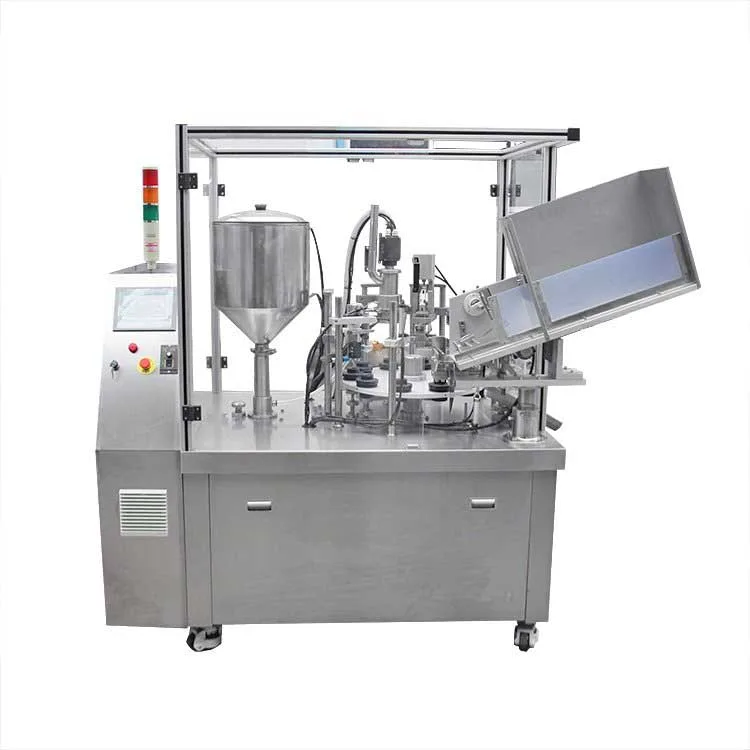
However, processing aluminum tubes presents distinct mechanical challenges compared to heat-sealable polymer containers. Aluminum requires precision mechanical folding and crimping (such as double folding, triple folding, or corrugated saddle folding) rather than thermal or ultrasonic melting. Achieving a hermetic, zero-leakage closure requires rigorous control over tube tail flattening, mechanical folding arm synchronization, code embossing pressures, and subterranean blow-off filling nozzles.
Core Engineering Objectives for Metal Tube Filling
When global engineering teams evaluate automated metal tube filling equipment, four technical criteria dictate overall equipment effectiveness (OEE):
- Hermetic Seal Integrity: Guaranteeing leak-proof mechanical folds under internal pressure without cracking the internal protective lacquer or outer aluminum sleeve.
- Volumetric Dosing Precision: Delivering repeat accuracy within ±0.5% using sanitary SS316L rotary piston pumps to eliminate expensive product giveaway.
- Cleanfill & Stringing Prevention: Utilizing positive blow-off or rotary cut-off nozzles to prevent viscous pastes from contaminating the tube tail sealing area.
- Automation & Orientation: Integrating photo-electric registration sensors for precise eye-mark alignment before crimping.
💡 Information Gain: Why Internal Lacquer Protection Matters
Standard market equipment frequently damages the internal epoxy-phenolic lining of aluminum tubes during aggressive mechanical folding, exposing formulations to raw aluminum oxidation. Engineering designs from EAC Machinery Co., Ltd. utilize polished, radius-curved folding jaws crafted from specialized tool steels with hardened surface treatments. This prevents micro-fracturing of internal protective coatings, preserving drug stability over a 36-month shelf life.