
Packaging Machinery Blog & Insights
Discover expert articles, technical guides, maintenance tips, and latest filling automation trends from EAC Machinery Co., Ltd.
Selecting a reliable Capsule Counting Machine manufacturer requires more than comparing prices or glossy product images. Buyers must examine counting accuracy, filling speed, dust control, changeover time, and service responsiveness. A machine may count thousands of capsules per hour, yet poor vibration control can create errors, stoppages, and costly rechecks.
This guide reviews leading Capsule Counting Machine manufacturers worldwide through a practical, evidence-based lens. It considers manufacturing experience, equipment design, quality systems, validation support, spare-parts access, and customer feedback. A strong supplier should explain how its sensors detect different capsule sizes, how its hopper handles fragile products, and how operators clean the contact surfaces between batches.
“Quality is not inspected into a product; it is built into the process,” said W. Edwards Deming, a respected quality-management expert. His principle remains highly relevant to capsule-counting equipment. Accurate output depends on engineering, calibration, maintenance, and operator training—not inspection alone.
The comparison is not perfectly simple. Public specifications can omit real production limitations. Some manufacturers report laboratory performance rather than routine factory results. That gap deserves attention. Readers should request trial data, acceptance-test records, and references from facilities with similar capsule formats.
The manufacturers discussed here represent different strengths, including high-speed automation, compact designs, flexible changeovers, and integrated bottle-filling lines. The best choice depends on production volume, regulatory expectations, floor space, and long-term support. A careful evaluation can prevent an impressive machine from becoming an expensive bottleneck.
Capsule Counting Machines: Types, Functions, and Key Industry Terms
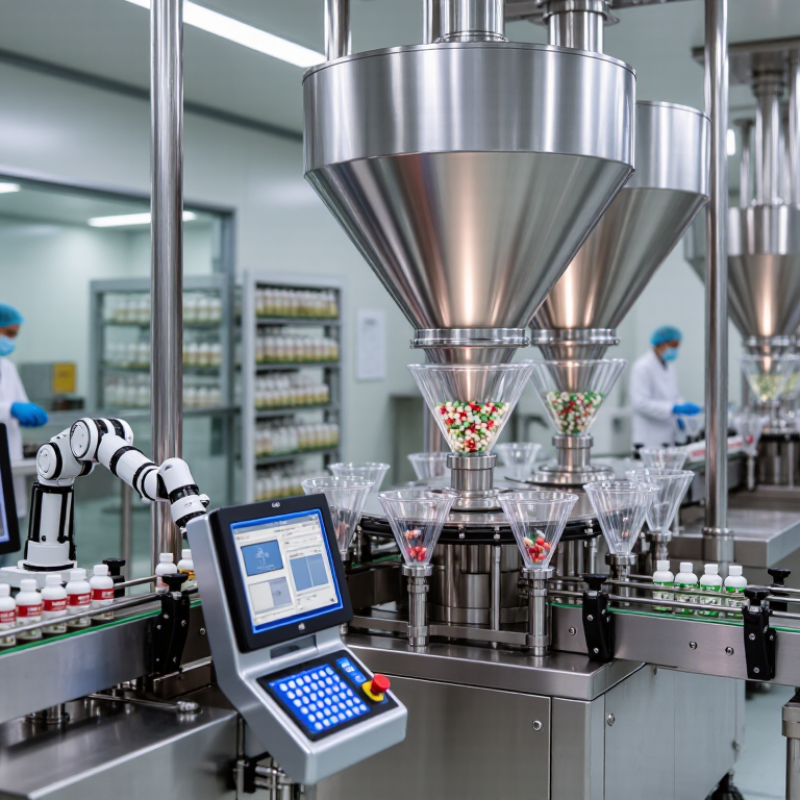
Capsule counting machines are designed for accurate, repeatable dosing in pharmaceutical and nutraceutical packaging lines. Common types include semi-automatic counters, automatic electronic counters, vibratory counters, and vision-based systems. Vibratory models separate capsules through controlled movement, while optical sensors detect each passing unit. Vision systems can identify shape, color, and visible defects, but they often require more calibration.
Key functions include counting, batching, bottle filling, rejection, dust control, and production data logging. Important terms include throughput, counting accuracy, changeover time, line clearance, and OEE. GMP procedures also require traceable records and controlled cleaning. A 2024 MarketsandMarkets analysis reported that the global pharmaceutical packaging market is expected to grow at more than 7% annually through 2028. That growth increases demand for faster, connected equipment. Yet speed alone is not enough. In real factories, powder buildup, static electricity, and mixed capsule sizes can reduce performance.
Tips: Test the machine with your actual capsule shell, fill weight, and speed. Ask for accuracy data across several batch sizes, not only ideal samples. Check tool-free changeover features and audit-trail capability. I would also inspect rejected capsules manually. Software reports can look perfect, but physical handling sometimes reveals problems. Choose equipment with accessible sensors, simple cleaning points, and documented validation support. A careful factory trial is usually more valuable than a polished brochure.
Top Capsule Counting Machine Manufacturers Worldwide? - Capsule Counting Machines: Types, Functions, and Key Industry Terms
| Machine Type | Counting Principle | Typical Output Range* | Suitable Capsule Formats | Main Functions | Common Applications | Key Selection Factors |
|---|---|---|---|---|---|---|
| Manual Capsule Counter | Operator-assisted visual or tray-based counting | Approximately 500–2,000 capsules per hour | Most standard hard capsules | Counting, dispensing, and small-batch filling | Pharmacies, laboratories, pilot production, and sampling | Low purchase cost, ease of cleaning, operator ergonomics |
| Electronic Linear Counter | Photoelectric sensors detect capsules passing through counting channels | Approximately 20–80 containers per minute | Hard capsules and selected tablets or softgels | Automatic counting, bottle filling, batch control, and reject handling | Small- to medium-scale pharmaceutical and nutraceutical packaging | Number of channels, sensor sensitivity, changeover time, dust control |
| Electronic Rotary Counter | A rotating disc separates and transfers capsules to counting outlets | Approximately 40–120 containers per minute | Hard capsules, tablets, and some coated products | High-speed counting, continuous feeding, and container indexing | Medium- and high-volume solid-dose packaging lines | Product shape, disc configuration, speed stability, cleaning access |
| Vision-Based Capsule Counter | Cameras and image-processing software identify and count individual capsules | Approximately 30–100 containers per minute | Capsules with varied colors, sizes, and surface characteristics | Counting, foreign-object detection, missing-dose detection, and inspection | Regulated pharmaceutical and quality-sensitive nutraceutical production | Camera resolution, lighting, software validation, data integrity |
| Automatic Bottle Counting Line | Integrated feeding, counting, bottle positioning, filling, and discharge | Approximately 60–150 containers per minute | Hard capsules and other solid oral dosage forms | Counting, bottle separation, filling, capping interface, and line monitoring | Large-scale contract packaging and pharmaceutical manufacturing | Line synchronization, container range, automation level, validation support |
| Multi-Format Counter | Adjustable guides, sensors, and software accommodate multiple product formats | Approximately 20–100 containers per minute | Different capsule sizes, tablets, and selected softgels | Product changeover, recipe management, counting, and electronic records | Facilities producing multiple products or frequent batch changes | Format flexibility, tooling requirements, recipe security, validation workload |
*Output ranges are typical industry values and vary according to capsule size, product characteristics, container dimensions, count quantity, machine configuration, and operating conditions.
FAQS
It counts capsules, creates batches, fills containers, and rejects suspected errors. It can also record production data. Accuracy matters.
Common types include semi-automatic, electronic, vibratory, and vision-based machines. Vibratory systems separate capsules through controlled movement. Vision systems inspect shape, color, and visible defects.
Rated speeds may range from 10,000 to 300,000 capsules per hour. Actual output depends on capsule size, shape, feeding, and conveyor movement.
No. Stable accuracy during long runs matters more than a maximum speed. A fast machine may struggle with dust, static, or uneven container movement.
On a 1,000-capsule test, the result could vary by about ten capsules. Request repeated tests using your actual capsule samples.
Test the machine with your capsule shell, fill weight, speed, and container type. Measure several batch sizes, not only ideal samples. Watch the rejects.
Powder buildup and mixed capsule sizes can reduce counting performance. Tool-free adjustments and accessible sensors may shorten changeover time. Small details matter.
Look for traceable production records, controlled cleaning procedures, calibration data, and audit trails. Operators should access clear controls and inspection points.
Run low, medium, and maximum speeds. Record interruptions, dust buildup, rejected capsules, and refill delays. A polished demonstration can hide weaknesses. I might overlook one too.
Conclusion
A Capsule Counting Machine is an essential piece of equipment for pharmaceutical, nutraceutical, and other regulated production environments, providing automated counting, filling, and quality-control functions. Machines vary from compact semi-automatic units to high-speed fully integrated systems, supporting different capsule sizes, materials, and production formats. As global demand for efficient packaging continues to rise, manufacturers are expanding production capacity while improving counting precision, operational flexibility, and system integration. Key evaluation criteria include processing speed, accuracy, ease of cleaning, changeover time, and compatibility with existing packaging lines.
Leading manufacturers are commonly compared by performance ranges of approximately 10,000 to 300,000 capsules per hour, with advanced systems designed to maintain accuracy within ±1% under stable operating conditions. Buyers should also assess sensor technology, rejection mechanisms, data recording, and user safety features. Compliance with GMP, FDA expectations, CE requirements, and documented quality-control procedures is critical for reliable operation. Selecting the right equipment requires balancing output, capsule formats, validation needs, maintenance support, and long-term production goals.